


314 Prompts for Mind-Bending Scientific & Philosophical Content Review + Bonuses

Apr 19
9 min read

What Is 314 Prompts for Mind-Bending Scientific & Philosophical Content?
This is a collection of 314 carefully designed prompts that help you generate deep, structured, nonfiction content around science and philosophy topics. But it goes way beyond just “ideas". Each prompt is built to generate:
A compelling title and subtitle
A full structured outline
Key arguments and counterpoints
Real scientific or philosophical grounding
A visual prompt for AI-generated imagery
The topics themselves are genuinely interesting. You’ll find ideas like:
The Simulation Hypothesis
The Fermi Paradox
Quantum Entanglement
Free Will vs Determinism
AI Alignment and Existential Risk
The Hard Problem of Consciousness
How to Turn Prompts into Publish-Ready Masterpieces (in One Session)
Step 1: Spark the Core Framework
Paste a prompt into ChatGPT. Boom: a full outline for articles, essays, scripts, or videos—complete with a killer title, subtitle, sections, and a cinematic image prompt tailored to your topic.
Step 2: Whip Up Eye-Catching Visuals
Grab that image prompt and feed it back to ChatGPT. Get a stunning, realistic, horizontal cinematic visual—no extra tools needed.
Step 3: Flesh It Out with Pro-Level Depth
Run each outline section through the included Special Companion Prompt. Watch it expand into 1,000 words of gripping narrative: verified facts, emotional hooks, and crystal-clear explanations—like a documentary script on steroids.
Step 4: Polish, Brand, and Launch
Stitch sections and visuals together. Slap on your branding and CTAs, then publish to YouTube, Amazon KDP, Medium, Substack, PDFs—wherever your audience hangs out.
The Payoff?
Zero to publish in hours, not days.
Rock-solid quality every time, across platforms.
Content that's educational, visual, and insanely shareable.
Master these 4 steps, and you'll have an endless stream of reality-shaking ideas at your fingertips.

About The Creator

314 Prompts for Mind-Bending Scientific & Philosophical Content is created by Paulo Gro, a prompt engineer who has clearly spent a lot of time refining what actually works when it comes to AI-generated content.
Paulo has built a wide range of prompt collections across different niches, including:
317 Prompts for Liberating Christian Self-Help Books
314 Prompts for Profound Midlife Self-Help Books
337 Prompts for Sci-Fi Sagas
346 Prompts for Cozy Girl Coloring Books
336 Prompts for Buddhist Wisdom Books
336 Prompts for Complete Romantasy Sagas
327 Prompts for Tiny Action Books
330 Prompts for Bad Joke Books
And many more...
314 Prompts for Mind-Bending Scientific & Philosophical Content Review - Key Features
✅ Structured Outlines for Nonfiction Content
Each prompt is designed to generate a complete outline for articles, essays, scripts, or educational videos. These outlines include sections such as background, key dilemmas, evidence, implications, counterpoints, and open questions. This ensures your content is not only well-organized but also persuasive and intellectually engaging.

✅ Compelling Titles and Subtitles
The prompts provide attention-grabbing titles and subtitles that frame topics as mysterious, controversial, or mind-expanding. This feature is particularly useful for creators who want to maximize clicks, shares, and audience engagement across platforms like YouTube, Medium, or Substack.
✅ Fact-Based Support
Unlike generic idea lists, these prompts are rooted in credible science, philosophy, and documented cases. They avoid fictionalization while still keeping the content thought-provoking. This makes your work trustworthy and appealing to audiences who value accuracy.
✅ Cinematic Visual Prompts
Each outline comes with a cinematic-style image prompt optimized for AI tools. These prompts help generate realistic, horizontal visuals that bring abstract concepts to life. The visuals add depth and engagement to your content, making it more shareable and memorable.
✅ Special Companion Prompt
This bonus tool allows you to expand any section of your outline into a polished, narrative-style nonfiction piece. It produces up to 1,000 words per section, blending verified facts with emotional resonance and accessible explanations. The result is content that reads like a high-quality documentary or essay.

✅ Versatility Across Platforms
The prompts are adaptable for multiple formats, including:
YouTube scripts with visuals
Amazon KDP nonfiction books
Medium/Substack essays
Social media threads (Twitter/X, LinkedIn)
Educational PDFs, e-learning modules, and infographics
This versatility ensures you can repurpose your ideas across different channels without losing quality.
✅ Time-Saving Workflow
The system is designed to take you from idea to publishable content in hours, not days. By eliminating the need for extensive research and brainstorming, it helps creators maintain consistency and avoid burnout.
✅ Coverage of 45 Proven Topics
Beyond the 314 prompts, the product highlights 45 powerful and highly shareable topics such as Roko’s Basilisk, the Mandela Effect, the Simulation Hypothesis, the Fermi Paradox, and the Trolley Problem. These topics have a proven track record of attracting massive audiences across books, podcasts, and social media.

✅ Scalable Content Production
By streamlining idea generation, structuring, and visual creation, the prompts make it possible to scale your content production. Whether you’re a solo creator or part of a team, you can consistently deliver high-quality work without exhausting your resources.
✅ Professional-Level Output Without a Team
The system empowers individuals to produce content that looks and feels professional—without needing a research team, designers, or consultants. This democratizes nonfiction content creation, making it accessible to anyone with curiosity and ambition.
How Much Does 314 Prompts for Mind-Bending Scientific & Philosophical Content Cost?
❤️ 314 Prompts for Mind-Bending Scientific & Philosophical Content Front End ($17)
When I picked up 314 Prompts for Mind-Bending Scientific & Philosophical Content, it was priced at just $17—and honestly, that felt pretty fair once I actually started using it.
You’re getting:
314 well-thought-out prompts
Clear, structured frameworks
And a companion tool that helps you expand ideas into full content
What surprised me the most is how much time it actually saved. Instead of spending hours researching or trying to figure out how to structure a topic, I could jump straight into creating. It took a lot of pressure off the whole process—especially that “what should I write next?” feeling.
And if you’ve been paying attention lately, you’ll notice this kind of content is everywhere. People are genuinely interested in deeper topics—things that make them think, question, and learn something new. This gives you a much easier way to tap into that… without needing to spend days putting everything together from scratch.
If you’re planning to create content in the science or philosophy space—or even just want a more structured way to work—it’s worth taking a look. You don’t have to go all-in right away. But for $17, it’s a pretty low-risk way to see if it fits your workflow.

The Upsells:
➡️ OTO 1: 766 Prompts for Mind-Bending Scientific & Philosophical Content – $27
Supercharge your original 314-pack with this expansion: a treasure trove of 766 fresh prompts diving into paradoxes, theories, and concepts that hook curious minds.
You'll get:
The same powerhouse structure—compelling titles, clear outlines, and cinematic image prompts—for instant content magic.
Topics from eternal philosophical puzzles to bold scientific what-ifs, ideal for books, videos, podcasts, blogs, and beyond.
A bottomless idea well to fuel your creativity without limits.
Multiply your output and keep inspiring audiences who crave big ideas.
➡️ OTO 2: 2,879 Prompts for Mind-Bending Scientific & Philosophical Content – $67
Level up massively with 2,879 unique prompts across 120 new categories like advanced science, ethics, metaphysics, and cognitive breakthroughs.
Each delivers:
Structured outlines, killer titles, and image prompts.
Seamless integration with your Special Companion Prompt for quick, narrative-driven nonfiction.
No fluff—just high-impact topics from cutting-edge theories to timeless dilemmas.
Why This Changes Everything
Pump out diverse content for months (or years) without burnout or repeats.
Tap new niches, test winners fast, and build authority across audiences.
Slash time from idea to publish—same proven structure, endless variety.
120 Fresh Categories Your Fans Will Devour: From Neural Correlates of Consciousness and Quantum Immortality... to The Ship of Theseus, Cyborg Rights, Lucid Dreaming, and "Do Parallel Universes Interact?" These are attention-grabbers for YouTube, podcasts, books, and social.
➡️ OTO 3 – 8,594 Prompts for Mind-Bending Scientific & Philosophical Content – $97
Dominate with 8,594 precision-crafted prompts across 358 groundbreaking categories in frontier science, deep philosophy, AI consciousness, quantum mysteries, and future ethics.
Everything integrates perfectly:
Outlines, titles, images—ready to roll.
Full Companion Prompt compatibility for polished narratives in minutes.
A lifelong edge in fact-packed, visually stunning content.
Your Content Empire Awaits
Stockpile years of unique, niche-deep material competitors can't match.
Flood platforms with fresh streams—YouTube, books, articles, podcasts.
End idea droughts forever and cement your expert status.
Sneak Peek: 358 New Categories - Explore Sentience in Non-Biological Systems, Hyperreality, The Ontology of Nothing, Quantum Gravity, Ethics of Thought Surveillance, and hundreds more—each primed for viral, thoughtful nonfiction.
Why Should You Choose 314 Prompts for Mind-Bending Scientific & Philosophical Content?
My Personal Experience With 314 Prompts for Mind-Bending Scientific & Philosophical Content:
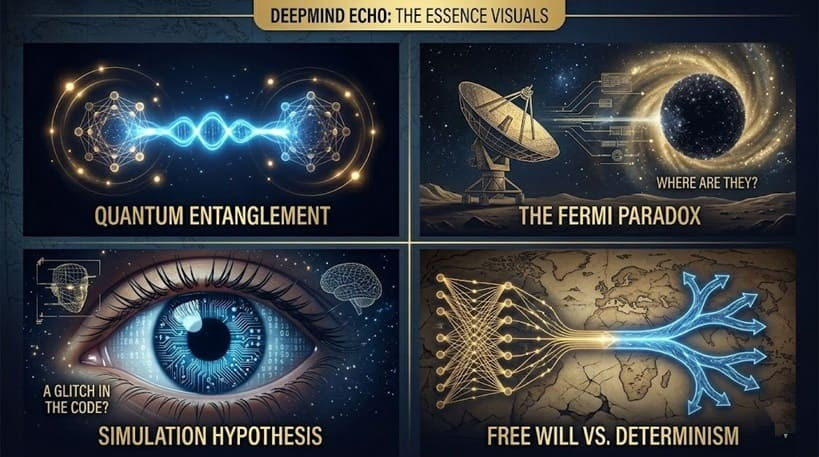
I created a small content project called “DeepMind Echo”—basically a mix of:
Medium-style long-form articles
Short-form posts for Facebook and X
A simple PDF guide I could potentially turn into a lead magnet
The idea was to focus on topics that make people pause and think, not just scroll past.

How I Actually Used It
I didn’t overcomplicate things. I followed the system exactly as suggested.
➤ Pick a Prompt
I started with topics like:
The Fermi Paradox
The Simulation Hypothesis
Free Will vs Determinism
Each prompt instantly gave me a structured outline.
The DeepMind Echo: Master Content Framework I. The "Threshold" (The Hook)
II. The "Code of Origins" (Foundations)
III. The "Core Dilemma" (The Tension)
IV. The "Pressure Test" (Deep Theory)
V. The "Modern Echo" (Implications)
VI. The "Glitch in the Logic" (Counterpoints)
VII. The "Event Horizon" (Unresolved Speculation)
VIII. The "Final Resonance" (Closing Reflection)
🎨 Visual Strategy for the Brand Every piece of content must have two specific visual assets:
|
➤ Expand the Sections
This is where the companion prompt came in. I just took each section and expanded it. And I only needed light editing to make it sound more like me.
➤ Add Visuals
I used the included image prompts to generate simple visuals. Nothing too fancy, but enough to make the posts stand out—especially on social platforms where visuals matter.
➤ Publish and Test
I published:
4 long-form articles
Around 8 short posts
I didn’t run ads or anything—just organic posting.
The Results
I’m not going to say this suddenly made me go viral overnight. But I did notice a few important things:
My posts got more meaningful engagement (longer comments, actual discussions)
People were saving and sharing the content more than usual
One of my articles brought in consistent traffic over several days, not just a quick spike
I picked up a small but relevant audience—people genuinely interested in these topics
Would I Recommend It?
If you’re serious about creating content in this niche—yes. Not because it’s magic, but because it removes a lot of the friction that usually slows you down. You still need to:
Edit your content
Add your voice
Stay consistent
But you’re no longer starting from zero every time.
For me, this turned out to be less about “314 prompts” and more about having a repeatable system I can rely on. And once you have that, creating content feels a lot less overwhelming.
If you’ve been stuck in that cycle of: “I know what I want to create… I just can’t seem to get it done consistently”. This might be the kind of tool that helps you finally move forward.
🔴Conclusion
That’s all what I want to share with you about 314 Prompts for Mind-Bending Scientific & Philosophical Content. I hope that my review can give you a helping hand in deciding what is best for you.
Important Reminder: When you purchase this product through my special link, you’ll unlock exclusive, valuable bonuses that you won’t find anywhere else! (Please note: these bonuses are only available with the full purchase-not with trial or free versions.)
To claim your bonus gifts, simply complete these two easy steps:
⏩ Step 1: Click the Buy Now button below to secure your copy of this product.

⏩ Step 2: Once your purchase is confirmed, just send a copy of your receipt to lokireviewteam@gmail.com. I’ll verify your order and personally send you all the details on how to access your bonus materials.


Comments