


Cowboy Legend AI Review – Can This “Infinite Western Story Engine” Really Build Your Graphic Novel Series?
- Paul

- Jan 26
- 9 min read
Cowboy Legend AI Review

If you’ve ever tried creating AI storybooks, comics, or illustrated KDP content, you already know the pain. Your main character looks heroic on page one…Then page two? Different face. Different clothes. Different art style. By page five, it looks like five different artists argued and all won. That character inconsistency alone has killed more AI book projects than lack of ideas ever did.
Cowboy Legend AI positions itself as the solution to exactly that problem — not just another prompt pack, but what it calls a “Dynamic Story Engine” designed to generate consistent, multi-character Western graphic novels in a few clicks. It focuses on character locking, story structure, and cinematic visuals, especially for creators targeting Amazon KDP, digital story content, and print-on-demand products.
So the big question is: Is this just cowboy-themed hype… or an actually usable system for real content creation?
Let’s dig in.
What Is Cowboy Legend AI?
Cowboy Legend AI is a web-based creative app built to generate 10-page Western-style graphic story kits with consistent characters, structured plots, dialogue, and cinematic-style visuals. Instead of giving you raw prompts, it acts more like a guided engine that handles story logic, character design consistency, and scene direction.
This tool combines two proprietary technologies:
Character DNA Lock™ – This ensures that once you define a character, their facial features and style remain consistent across every page. No more morphing faces or random glitches.
Chaos Engine – A procedural logic system that generates coherent plots, mixing villains, goals, and twists into structured narratives.
Each “story kit” typically includes:
1 Cover
10 sequential story pages
Multi-character scenes (hero, sidekick, villains)
Western-themed dialogue and FX
Formats ready for both landscape and portrait layouts
So instead of designing everything from scratch, you’re essentially steering a story machine.

About The Creator

Cowboy Legend AI was developed by Emanuele Maugeri, an entrepreneur and creative tech builder who’s clearly spent serious time in the trenches of AI content creation. He’s also behind a range of other AI-focused tools and creative frameworks, including Comic Kiddo AI, Ideogram Story Protocol, Joyful Mind Wisdom, AI Storytelling Generator, Viral Podcast AI, Millionaire Vision Boards, Futuristic Art Genesis Prompts and many more.
Cowboy Legend AI Review - Key Features
✅ Character DNA Lock Technology
One of the biggest problems with AI-generated storybooks or comics is that characters constantly change — different faces, outfits, proportions, or art styles from page to page. Cowboy Legend AI tackles this with its Character DNA Lock (Master Character Block) system.
What this does:
Keeps your main characters visually consistent across every scene
Locks facial structure, visual identity, and style
Allows recurring heroes, sidekicks, and villains to look like the same people throughout the story
This is crucial if you want to build:
A book series
Recognizable characters
Brandable story IP for merch or repeat titles
Instead of “random AI art,” you get something that behaves more like a controlled character design system.
✅ Procedural Story Logic (Auto Plot Structure)
Cowboy Legend AI doesn’t just spit out disconnected images. It follows a story framework automatically. The engine structures your content into a narrative flow like:
Introduction → Action/Conflict → Climax/Resolution
That means:
Scenes feel connected
The story progresses logically
You’re not stuck manually planning every page before generating
This is especially helpful for creators who are strong on ideas but don’t want to outline every single panel or page.
✅ Cinematic AI Direction
The system is built to guide image creation with cinematic composition, not flat or generic framing. This includes:
Dynamic camera angles
Depth and lighting direction
Full-scene compositions instead of simple portraits
The result is pages that feel closer to animated movie scenes or graphic novel panels, which is ideal for visual storytelling, children’s books, and illustrated content.
✅ Built-In Dialogue & Sound Effects
Unlike many AI art tools that only generate images, Cowboy Legend AI also handles story dialogue elements. It can generate:
Speech bubbles
Character dialogue
Visual sound effects (like “BOOM!”, “SWISH!”, etc.)
That moves your output from “illustration” into comic-style storytelling, reducing the need to add text manually in other design tools.
✅ Multi-Character Scene Handling
Generating one character is easy. Generating multiple characters in the same scene without visual chaos is not. This engine is built to support:
Hero + sidekick scenes
Villain confrontations
Group interactions
The goal is to keep characters recognizable and properly placed within the same visual frame — something that’s usually tricky with general AI image tools.
✅ 5 Pre-Built Story Worlds
To avoid starting from a blank slate, Cowboy Legend AI includes five themed “Legendary Worlds” you can build stories inside:
Sheriff Squad
Animal Legends
Wild West Magic
Cowgirl Adventures
Funny Outlaws
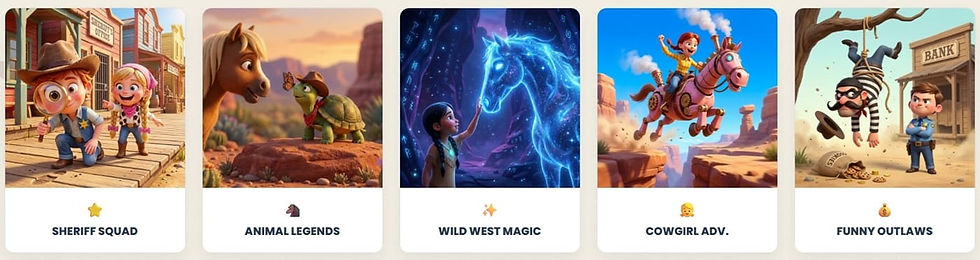
These act like pre-designed universes with tone and character styles, helping you create themed series faster.
✅ Dual-Format Output (Landscape + Portrait)
The system supports two major layout formats:
Cinematic Landscape (3:2) Best for:
Digital screens
Video storytelling
YouTube-style visual content
Book Portrait (2:3) Best for:
Amazon KDP paperbacks (like 6x9")
Mobile reading formats
Standard book layouts

✅ “Chaos Engine” for Infinite Variations
Behind the scenes, Cowboy Legend AI uses a variation system that mixes:
Different villains
Goals
Twists
Situations
This helps generate new combinations so your stories don’t feel like the same plot recycled over and over. It’s designed for creators who want to produce multiple books or episodes, not just one.
✅ 10-Page Story Kit Generation
Instead of single images, the system can generate a complete mini-story package, typically including:
1 Cover
10 sequential story pages
That gives you a ready foundation for a short illustrated book or comic episode, rather than isolated assets.
✅ Bonus Support Tools
The system also includes supporting assets like:
Negative prompt packs to reduce common AI visual glitches
Style/atmosphere modifiers
Niche ideas to guide what type of stories you create
These extras are meant to help reduce technical friction and speed up your workflow.
✅ Commercial Use Focus
Cowboy Legend AI is positioned for creators who want to publish or sell, not just experiment.
It’s built with use cases like:
Amazon KDP books
Digital story products
Print-on-demand merchandise
Client work (like custom storybooks)
So the feature set leans heavily toward production and output, not just art generation.
How Much Does Cowboy Legend AI Cost?
❤️ Cowboy Legend AI Front End ($17)
When I picked up Cowboy Legend AI, the price honestly surprised me. It’s currently $17 as a one-time payment, compared to the listed regular price of $97.
Inside the package, you’re getting access to the Cowboy Legend AI Core Engine, the 5 Legendary Category Presets (so you’re not starting from scratch), and the Frontier Bonus Package, plus commercial rights to use what you create. They also include a 14-day money-back guarantee, which made the decision easier on my end. I figured I could test it on a small project first and see if it actually fit my workflow.
If you’ve been curious about creating illustrated story content but keep getting stuck with inconsistent AI results, this is one of those tools that’s inexpensive enough to try without overthinking it — and structured enough to be genuinely useful if it clicks with how you like to work.

The Upsells:
➡️ OTO 1: The Frontier Director – $27
This upgrade gives you more control over the storytelling side. You unlock a Director Mode dashboard, where you can guide the story by choosing custom villains, character goals, and plot twists instead of relying only on default combinations. It also adds three new themed worlds, which really expand what you can create beyond classic Western settings:
Galactic Frontier – space-style adventures
Jurassic West – dinosaurs mixed with frontier themes
Steampunk Inventors – mechanical, invention-driven worlds
If you like steering the story direction instead of letting everything run automatically, this is the upgrade that makes the system feel more hands-on.
➡️ OTO 2: The Artistry Suite – $37
This one focuses on visual style variety. Instead of sticking to one core look, the app turns into more of a multi-style art studio. You unlock five additional rendering styles:
Coloring Book
Manga
Vintage Pulp
Watercolor
Spaghetti Western
It also includes a Character Forge feature, which lets you design more custom heroes instead of only working with preset character types. If your goal is to create different kinds of books or visual products across multiple niches, this upgrade gives you a lot more visual flexibility.
➡️ OTO 3: The Publishing Powerhouse – $67
This upgrade is about going bigger. Instead of short story kits, you can create full-length 30-page graphic novels. It unlocks the Saga Architect Engine, which adds deeper storytelling tools like:
A Side-Quest system for extra subplots
An Atmospheric Arc system to help maintain tone and progression over longer stories
If you’re serious about building full books or ongoing series rather than short episodes, this is the expansion that supports long-form content.
➡️ OTO 4: Commercial Tycoon License – $97
This is the business-focused upgrade. It’s aimed at users who want to move beyond personal projects and into offering services or partnerships. It includes:
White label source codes for the apps
Eligibility for a high-commission partnership level
Commercial reseller-style rights to provide related creative services on platforms like freelance marketplaces
This one is less about storytelling features and more about turning what you create — or the system itself — into a service-based or resale opportunity.
Why Should You Choose Cowboy Legend AI?
My Personal Experience With Cowboy Legend AI:
I created a short story project called “Rusty & The Midnight Train Heist”. The idea was simple: a brave young sheriff, a clumsy gang of outlaws, and a night-time train robbery gone wrong.
I wanted to test three things:
Character consistency
Story flow
How much manual fixing I’d need afterward
⏩Setting Things Up
Instead of writing long prompts like I normally do, I selected one of the sheriff-style story worlds and let the engine handle the structure. That alone felt different — I wasn’t stuck in “prompt engineering mode,” trying to guess the perfect wording.
Within a short time, I had:
A cover scene with Rusty standing in front of a moonlit desert
Sequential pages showing the outlaws attempting the robbery
Action scenes with multiple characters in the same frame
Dialogue and sound effects already placed into the scenes
Normally, getting that far would involve bouncing between AI tools, image editors, and text layout apps.

⏩The Biggest Difference: Character Consistency
This was the part that genuinely stood out. Rusty actually looked like the same character across the pages — same face, same visual identity, same style. In past projects, this is where everything usually falls apart. I’d end up discarding half the images because the character suddenly looked like someone else.
Here, I didn’t feel like I was fighting the AI every step of the way. I was reviewing and choosing, not constantly regenerating in frustration.

⏩Story Flow & Visual Feel
The sequence didn’t feel random. It felt like a short comic episode:
Setup
Problem
Action
Resolution
That made it much easier to imagine turning it into a real book or digital story, because I wasn’t trying to force disconnected images into a storyline afterward.
The scenes also had a cinematic feel — wider angles, more “movie-like” compositions instead of stiff character poses. That made the pages look more like story panels than just illustrations.
⏩How Much Editing Was Still Needed?
It wasn’t “click once, publish instantly.” I still had to:
Adjust some text placement
Clean up spacing for layout
Choose which scenes worked best
But here’s the key difference: I was polishing a draft, not building from zero. Instead of spending hours trying to get usable material, I started with something that already looked like a structured story and refined from there. That shift alone saved a lot of mental energy.
⏩The Real Benefit I Noticed
The biggest change wasn’t just speed — it was reduced friction.
I didn’t feel that usual creative burnout that comes from fighting inconsistent AI outputs. The process felt more like guiding a story assistant than wrestling with a slot machine.
For anyone trying to produce:
Short illustrated books
Mini comic-style stories
Visual storytelling content
…this kind of structured starting point makes the whole workflow feel more doable, especially if you want to create more than just one project.
Final Take
Cowboy Legend AI didn’t replace creativity, and it didn’t eliminate editing — but it removed a lot of the chaos that normally makes AI story projects exhausting.
For me, it turned “this might take days and still look inconsistent” into “I have a solid draft story I can actually finish.” And in content creation, getting to a finishable draft is often the hardest part.
If you’ve struggled with characters changing every page or stories feeling like random images glued together, Cowboy Legend AI felt like a breath of fresh air. It eliminated the frustration of “prompt hell” and gave me a tool that actually delivered a finished product. If you’re serious about publishing or storytelling, this is worth the investment.
🔴Conclusion
That’s all what I want to share with you about Cowboy Legend AI. I hope that my review can give you a helping hand in deciding what is best for you.
Important Reminder: When you purchase this product through my special link, you’ll unlock exclusive, valuable bonuses that you won’t find anywhere else! (Please note: these bonuses are only available with the full purchase-not with trial or free versions.)
To claim your bonus gifts, simply complete these two easy steps:
⏩ Step 1: Click the Buy Now button below to secure your copy of this product.

⏩ Step 2: Once your purchase is confirmed, just send a copy of your receipt to lokireviewteam@gmail.com. I’ll verify your order and personally send you all the details on how to access your bonus materials.


Comments